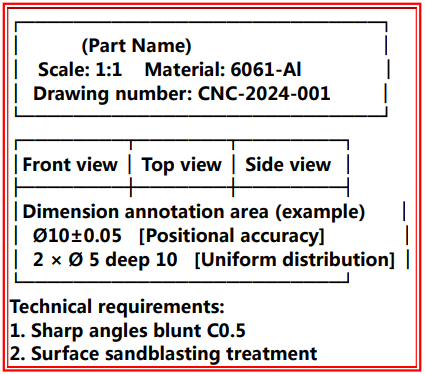
 CNC machining, or Computer Numerical Control machining, is a manufacturing process that uses pre-programmed computer software to control the movement of machinery and tools. It is widely used for precision machining of metal, plastic, wood, and other materials. Here’s a breakdown of key aspects of CNC machining:
1. How CNC Machining Works
-
A CAD (Computer-Aided Design) model is created.
-
The CAD file is converted into G-code (machine instructions) using CAM (Computer-Aided Manufacturing) software.
-
The CNC machine (mill, lathe, router, etc.) follows the G-code to cut, drill, or shape the workpiece with high precision.

2. Types of CNC Machines
-
CNC Mills – Use rotating cutting tools (3-axis, 4-axis, or 5-axis) for milling operations.
-
CNC Lathes – Rotate the workpiece while a cutting tool shapes it (ideal for cylindrical parts).
-
CNC Routers – Used for cutting softer materials like wood, plastic, and foam.
-
CNC Plasma Cutters – Use a plasma torch to cut metal sheets.
-
CNC Laser Cutters – Utilize a high-power laser for precise cutting.
-
CNC EDM (Electrical Discharge Machining) – Uses electrical sparks to shape hard metals.
3. Advantages of CNC Machining
-
High Precision & Accuracy – Tolerances as tight as ±0.001 inches (0.025 mm) are possible.
-
Repeatability – Ideal for mass production of identical parts.
-
Complex Geometries – Can produce intricate shapes that are difficult with manual machining.
-
Automation – Reduces labor costs and human error.
-
Material Versatility – Works with metals (aluminum, steel, titanium), plastics, composites, and more.

4. Common CNC Machining Processes
-
Milling – Removing material with rotating cutters.
-
Turning – Rotating the workpiece against a stationary tool (for cylindrical parts).
-
Drilling – Creating holes with precision.
-
Grinding – Finishing surfaces to high smoothness.
-
Swiss Machining – Specialized for small, high-precision parts.
5. Industries Using CNC Machining
-
Aerospace (turbine blades, engine components)
-
Automotive (engine parts, gears)
-
Medical (surgical instruments, implants)
-
Electronics (heat sinks, enclosures)
-
Defense & Military (firearm components, armored parts)
-
Prototyping & R&D (fast, precise part production)
6. CNC Programming (G-code Basics)
Example of a simple G-code command:
G01 X10 Y20 F100 (Linear move to X=10, Y=20 at feed rate 100)
M03 S1000 (Spindle on clockwise at 1000 RPM)
7. Future Trends in CNC Machining
-
AI & Machine Learning – Predictive maintenance, adaptive machining.
-
Automation & Robotics – Lights-out manufacturing (unmanned production).
-
Hybrid Manufacturing – Combining CNC machining with 3D printing.
-
IoT & Smart Factories – Real-time monitoring and optimization.
Would you like more details on a specific aspect of CNC machining (e.g., programming, materials, or applications)? |